Acute Toxicity of Ferrous Sulphate Heptahydrate in Freshwater Catfish Pangasius pangasius: A 96-hour LC50 Assessment
Aditi Shivhare
Department of Zoology, Govt. Nagarjuna Post Graduate College of Science, Raipur, Chhattisgarh, India.
Pallavi Sinha *
Department of Zoology, Govt. Nagarjuna Post Graduate College of Science, Raipur, Chhattisgarh, India.
*Author to whom correspondence should be addressed.
Abstract
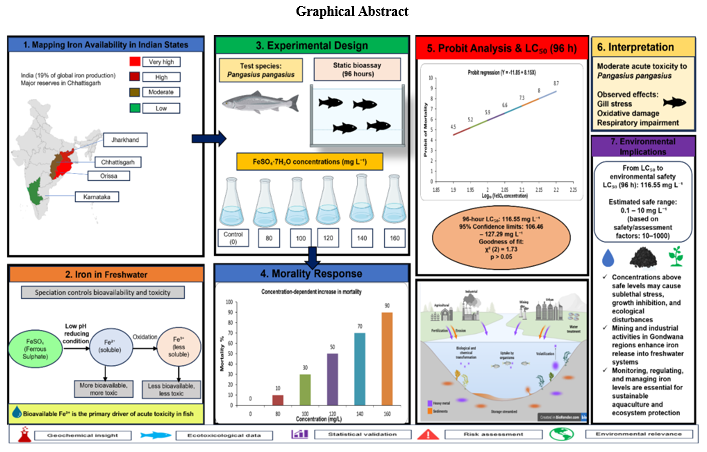
Aims: This study aims to calculate the 96-hour median lethal concentration (LC₅₀) of ferrous sulphate heptahydrate (FeSO₄·7H₂O) in Pangasius pangasius and evaluate the concentration-dependent acute toxicity of dissolved ferrous iron under controlled laboratory conditions.
Study design: Experimental laboratory-based acute toxicity study using a 96-hour static bioassay.
Place and Duration of Study: Department of Zoology, Govt. Nagarjuna Post Graduate College of Science, Raipur, Chhattisgarh, India, in collaboration with Columbia Institute of Pharmacy, Raipur, India. The study was conducted under controlled laboratory conditions.
Methodology: Healthy fingerlings of Pangasius pangasius (mean length 9.0 ± 0.5 cm; mean weight 8.0 ± 1.0 g) were acclimatized for 14 days before experimentation. Fish were exposed to five nominal concentrations of ferrous sulphate heptahydrate (FeSO₄·7H₂O) (80, 100, 120, 140, and 160 mg/L) along with an untreated control for 96 hours under static bioassay conditions. Each treatment consisted of three replicates with ten fish per replicate. Mortality was recorded at 24-hour intervals. Water quality parameters, including temperature, pH, dissolved oxygen, total hardness, and alkalinity, were maintained within acceptable limits throughout the experiment. Mortality data were converted to probit values and analysed using linear regression to estimate the 96-hour LC₅₀ and its 95% confidence interval.
Results: Mortality increased in a concentration-dependent manner from 10% at 80 mg/L to 90% at 160 mg/L after 96 hours of exposure. The probit regression model showed an excellent concentration-response relationship (R² = 0.9854; P = 0.00075). The calculated 96-hour LC₅₀ value for ferrous sulphate in Pangasius pangasius was 116.55 mg/L, with a 95% confidence interval of 110.34–123.10 mg/L. The regression equation obtained was Y = –11.85 + 8.16X, indicating a strong linear relationship between log₁₀ concentration and probit mortality.
Conclusion: Ferrous sulphate exhibited moderate acute toxicity to Pangasius pangasius, with toxicity increasing significantly as concentration increased. The LC₅₀ value generated in this study provides baseline toxicological information for freshwater ecotoxicological risk assessment and supports the development of water quality guidelines for sustainable aquaculture and management of iron-contaminated freshwater ecosystems.
Keywords: LC₅₀, ferrous sulphate heptahydrate, pangasius pangasius, freshwater ecotoxicology, acute toxicity, probit analysis, iron contamination, fish bioassay, aquatic toxicology, metal stress